Behind the story: Health body’s shift on antisemitism
Being accountable to my readers by showing you my working
I have a new report in Deepcut News showing the Australian health regulator bowed to pressure to adopt a contentious definition of antisemitism, even after some members of the board expressed "reservations about the potential for its examples to conflate legitimate political criticism of the State of Israel with antisemitism".
Here's an extract from the story:
Internal files obtained by Deepcut News under freedom of information laws show the chief of the Australian Health Practitioner Regulation Agency (AHPRA) told his colleagues there was "heightened external pressure on a range of public sector bodies" to adopt the International Holocaust Remembrance Alliance (IHRA) definition.
They reveal that "some members" of the AHPRA board raised concerns in February "that the IHRA definition is not fit for regulatory purposes due to its lack of clarity and the political elements embedded within it".
You can read the full piece here:
 Daniel Hurst
I believe getting to the bottom of these deliberations is in the public interest because AHPRA and its 15 related national boards play a powerful role. They have oversight of nearly 1 million Australian health practitioners including doctors, nurses and psychologists, so what they adopt as policy matters. Anything that could be seen as unfairly restricting criticism of Israel also raises free speech concerns that are worth exploring.
I also believe in "showing my working" to readers, hoping this will help to build trust at a time when many people question what they read in the media and how they can know it is true (I wrote about that in my first post here).
So here are the main steps I took to research and report this story:
- Submitted a Freedom of Information (FOI) application to AHPRA on July 8 seeking documents from November 2025 onwards in relation to the adoption of the IHRA definition, including board meeting minutes and agendas, risk assessments, and email correspondence about the announcement. The deadline for a decision was later extended from August to September as AHPRA said it needed time to consult third parties named in the documents.
- Read through the official transcript of the antisemitism royal commission’s July 29 hearing when the AHPRA CEO gave evidence, to find the most relevant comments and understand the public rationale for the IHRA policy shift.
- Read other public documents as part of the research process, including AHPRA's review into management of notifications relating to racism and discrimination, its updated social media guidelines, the Special Envoy to Combat Antisemitism's April handbook, and Justice Fagan’s ruling that criticised the IHRA definition.
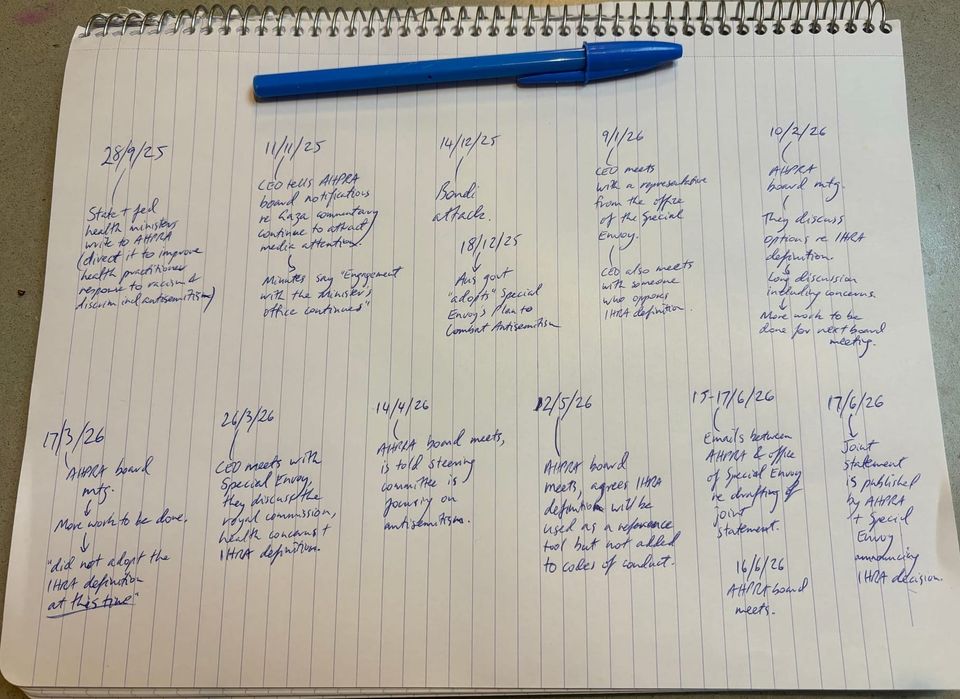
- Received the bundle of 24 documents from AHPRA on September 15 and went through them in order to find the most significant information. As there was so much material to sift through, jotted down the key dates and decisions on a piece of paper to help get a sense of the timeline.
- Contacted AHPRA to give them the opportunity to comment (aka the "right of reply") if they wished.
- Finished writing the story. Went through the story line by line to double-check every claim made against the original documents. Filed the story to the editor.
So how can you trust that the documents say what I say they do? Deepcut has also posted a link where you can download all of the documents released in response to my FOI application. I should also make clear that at no stage of the research or writing process did I use any AI tools whatsoever.
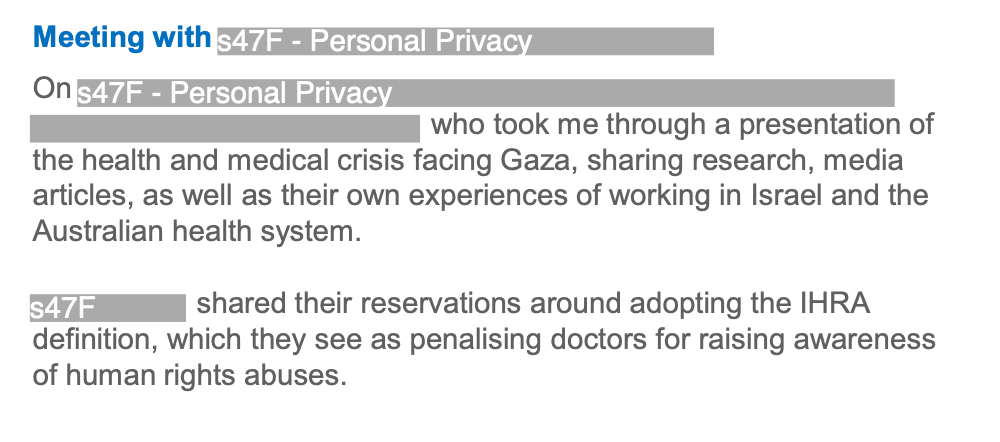
If you don't know what's in the IHRA definition, you can find the full text and its set of examples here. Defenders of this definition, including the Australian government, say it is a useful “reference tool” and doesn’t prevent “legitimate” criticisms of the Israeli government.
I have always worked hard in all of my reporting to ensure Jewish people are not held collectively responsible for the actions of the Israeli government. That’s important (similar to what we would say about any other diaspora group) and is consistent with one of the lines in the IHRA text. Some of the other examples, though, are imprecise and open to wide interpretation.
The IHRA text says “criticism of Israel similar to that levelled against any other country cannot be regarded as antisemitic” - a statement that does not countenance the possibility that, due to its own actions, Israel might justifiably be subject to criticisms - including from international courts and human rights watchdogs - that aren’t routinely levelled at most other countries.
One of the most interesting moments from the AHPRA chief’s testimony to the royal commission in July was when he couldn’t give an ironclad commitment that a health practitioner agreeing with an international court ruling would be safe from accusations of antisemitism. Likely not a problem, he said, but it would depend on the context. He said a more detailed handbook issued by the Special Envoy to Combat Antisemitism in April was a helpful guide and was one of the reasons AHPRA had shifted from its previous opposition to adopting the IHRA definition. One of the pages near the end of that document suggests that using terms like apartheid in relation to Israel is antisemitic. But the International Court of Justice found in a landmark advisory opinion in 2024 that Israel was in breach of the prohibition on racial segregation and apartheid (more details on that ruling in my analysis piece from 2024).
So it’s not really a surprise to find one of the newly obtained documents from the AHPRA board warned that the IHRA definition “may create further ambiguity”. That matters when some of the most compelling accounts of what is happening in Gaza have come from health practitioners.
Further reading:
- My story in Deepcut News on what the new FOI documents show
- IHRA lead drafter Kenneth Stern’s 2019 op-ed on how the definition was being weaponised to chill academic freedom and free speech
- My first blog post on big tech, AI and trust in journalism
If you liked this piece, share it with a friend. If you haven’t already, sign up to the newsletter to get an email whenever I write a new piece. Don’t be at the mercy of an opaque algorithm!
