Sub-par: Australia's $368 billion gamble
A deep dive into what I found out - and what remains secret - after my 13 freedom of information applications relating to the AUKUS pact.
It was 7.18pm on August 31, 2021, when the then head of Australia's defence department thanked one of his top advisers for a positive update on the French project to acquire submarines. The advice had been that the French firm Naval Group's offer to proceed to the next stage of work was "affordable and acceptable".
"I will ensure that the good progress to date is part of the advice we take to Government, and you will hear that message repeated in the 2+2 [meeting] with France and in other engagements," emailed Greg Moriarty, the department chief who would later become the Australian ambassador to the US.
Just two weeks after this private email about “good progress”, the project was dead and buried. The Australian government had made one of its most seismic strategic calls of this generation, abruptly dumping the French project and instead locking in plans to work with the US and the UK to equip Australia with its own fleet of nuclear-powered submarines (and collaborate on other defence projects too).
**
The first the Australian public heard of this u-turn was when Scott Morrison (in the words of Joe Biden, "That fella down under") popped up in a three-way video conference announcement with Biden and the UK's then PM, Boris Johnson, broadcast live on the news networks at 7am Canberra time. The French cried betrayal. Neighbours such as Indonesia were shaken by the news. Totes AUKUS.
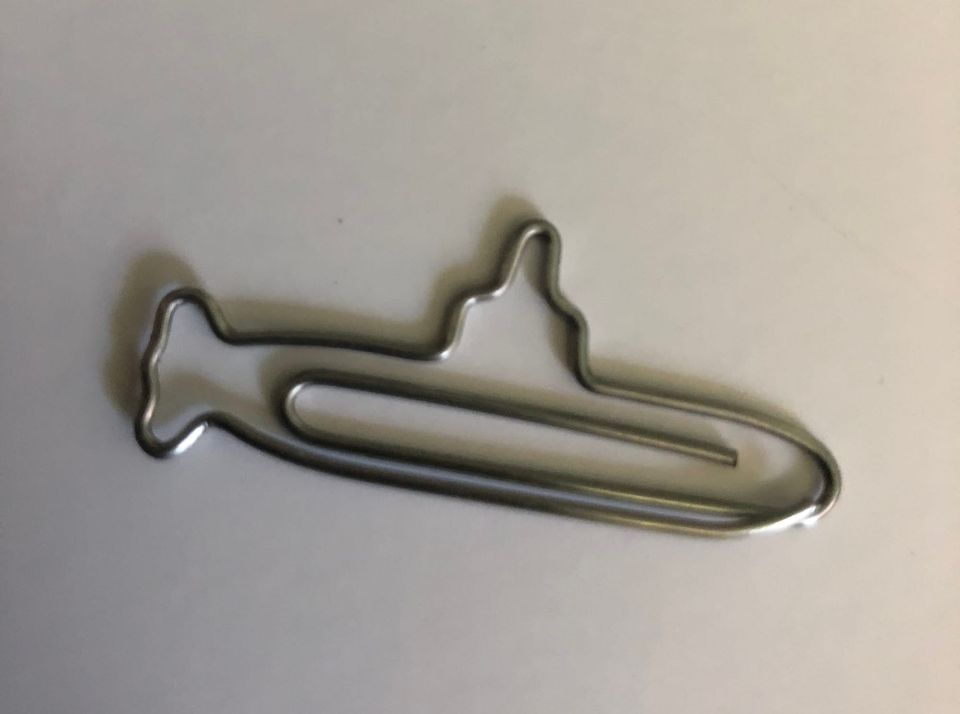
Labor quickly locked in its support for the deal. The official reason is it accepted advice from security officials that Australia needed nuclear-powered subs to contend with the deteriorating strategic circumstances in the region (read: China). But politics can be a powerful motivator: the then-opposition knew it would be accused of being weak on national security in the lead-up to the 2022 election if it kicked up a stink. Morrison may have championed AUKUS, but it wasn't until Anthony Albanese was in power that the three countries actually settled on the details – and with it the eye-watering price tag for the Australian public: up to $368 billion in total over the next few decades. Fun fact: the estimated multi-decade price tag was revealed in March 2023, the same day journalists were handed fact sheets held together with custom-made submarine-shaped paperclips you can see in the image at the top of this post.
Given the significance of Australia placing its AUKUS pact with the US and the UK at the heart of its defence planning, I've used Freedom of Information (FOI) laws extensively over the past five years to try to shed light on the process that led to this shift and the consequences. That's where that pre-AUKUS email exchange at the top of this post comes from. By my count, I've submitted at least 13 FOI applications related to AUKUS, including to the Department of Defence (and its submarine agency), the Department of Foreign Affairs and Trade, and the Department of the Prime Minister and Cabinet.
I wrote stories about these documents at the time, but part of the normal process of FOI-based investigations is that the department involved will post the full documents online on its "disclosure log" within a couple of weeks. The idea is that if a document is deemed suitable for public release, it shouldn't be restricted only to the journalist or researcher who applied. It belongs to the voting public. What's more, making the full document available is important so people can make up their own minds on whether any important context was left out of news coverage. While news stories will give a best attempt at summarising the most noteworthy parts of an FOI document, such reports fade from memory quickly so the disclosure log is – or should be – an enduring public resource.
Small problem. I recently discovered the Department of Defence routinely deletes the FOI documents after a couple of years. Searches using the Wayback Machine show the Defence website used to say: "Information in the disclosure log is removed after 24 months, unless the information has enduring public value." That was 2023. Now it just says: "Information published in the disclosure log is removed after 2 years." Nothing more about "enduring public value".
So for the sake of keeping the public informed on the workings of its own governments, I'm now publishing all of the AUKUS-related FOI documents I've received. Whether you support AUKUS or you don't, surely we can all get behind the need for transparency around such big decisions. Explore them in a dedicated new page on my website called The AUKUS files:
As you'll see, documents show the origins of the secret planning within Defence for a possible 'Plan B' in parallel to ongoing work on the French submarine project. One such review was afforded "the highest priority", an internal document from 2021 said. At the same time, officials were trying to iron out issues with the still-live French submarine project, culminating in the "good progress" email two weeks before the contract was axed.
The AUKUS files include two highly technical emails to the French company - one of them eight days before the AUKUS rupture and the other mere hours before the announcement - that worked through procedural steps required to move to the next phase of the contract. It's no wonder the French felt they were blindsided (remember Emmanuel Macron's "I don't think, I know" line about whether Morrison had lied to him in the lead up to the decision) but the letters don't explicitly promise government authorisation to proceed. Quick reminder: France does make nuclear-powered submarines, but it was the Australian government that had originally asked it to make a conventionally powered version.
The documents I obtained through the FOI applications also include the former Labor PM Paul Keating's private warnings to the federal government against proceeding with the deal. Keating wasn't shy about expressing these views in public, but FOI digging established how the Labor elder statesman conveyed his reservations in a mini-essay to Albanese in January 2023 (weeks before Albanese locked in the details of the AUKUS plan in a big ceremony in San Diego in March 2023). In that document, Keating said Australia's interests were served by a close relationship with the US but not at any cost. He made the point US and Australian interests were not identical.
"Australians have glossed over our role in Washington's poor decision-making since the end of the Cold War, convincing ourselves that the contribution we made was minor. But we can't let ourselves off the hook. We have to be sure that we are not again standing by while major and dangerous decisions are being made."
Then on March 15, 2023, Keating sent a private email to cabinet ministers that would not be a comfortable one to receive, suggesting they had collectively made the worst Labor decision since conscription:
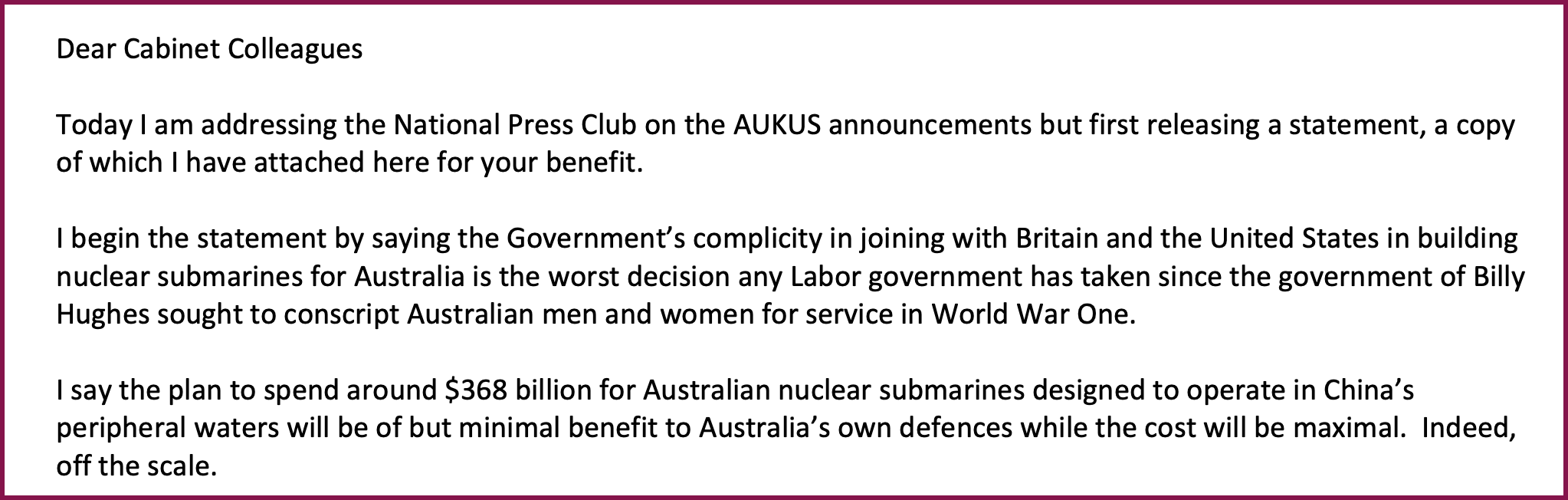
Keating's email ended with an acknowledgement that his views would "not please the Prime Minister, the Foreign Minister nor the Defence Minister" but he said the country was "entitled to a rationale for such a radical and dangerous policy".
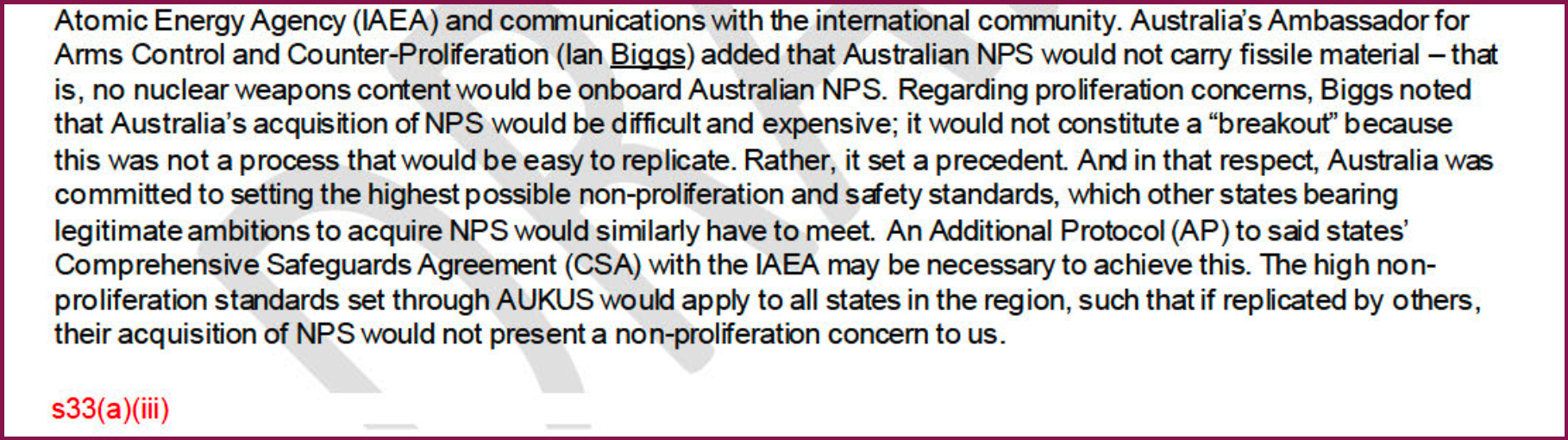
While the public criticism of AUKUS was playing out, Australian officials were privately trying to reassure the diplomatic corps in Canberra that the pursuit of nuclear-powered submarines was being done in a transparent and responsible manner. Another document showing the contents of briefings to foreign diplomats reveals Australia's ambassador for arms control and counter-proliferation described the plan as "difficult and expensive" and not "easy to replicate". This was meant to convince diplomats that AUKUS would not spur a raft of other countries to follow suit, but also happened to underline the challenges and costs of Australia actually making this plan a reality.
Some details, though, were blocked from public release. Most notable is the Australian Submarine Agency's reluctance to release schedules for the billions of dollars Australia is sending to the US and the UK to prop up those countries' own defence industries. The rationale is AUKUS will only work if those countries are able to clear up their own backlogs. One problem is there doesn't appear to be any mechanism to claw back that money if the US or UK end up failing to deliver.
**
Why does this all matter (beyond the financial cost to be borne by taxpayers, which, you may notice, is never subject to the same scale of scrutiny as other areas of government for potential budget cuts)?
In the public discussion about AUKUS, there has been a lot of focus on whether the new submarines will arrive on time, late or not at all. This is a worthwhile line of investigation, because of clear evidence that the US is not building submarines at a rate to meet its own stated needs, and that the US president will ultimately need to certify that transferring at least three submarines to Australia in the 2030s won't degrade that country's own military.
But there seems to have been less focus on the big-picture strategic dimensions of AUKUS. From the perspective of the US, the motivation was written on the tin on day 1. A senior Biden White House official - trumpeting the AUKUS decision in a press briefing right at the beginning - labelled it “a fundamental decision, that binds decisively Australia to the United States and Great Britain for generations”. Pause for a moment to think about that language: Binds. For generations.
Also in 2021, senior Biden administration official Kurt Campbell said AUKUS would lead to “a deeper interconnection and almost a melding in many respects of our [military] services and working together on common purpose that we couldn’t have dreamed about five or 10 years ago”. According to the AFR's James Curran, Campbell later told European officials privately that AUKUS was about “getting Australia off the fence – we have them locked in now for the next 40 years”. Binding, melding, locking in.
One of the issues raised by the AUKUS decision is how much it might constrain Australia's sovereign decision-making on defence and national security matters. Australia is relying on the US to sell at least three Virginia-class submarines to Australia in the 2030s, before Australia's own Adelaide-built submarines are meant to start entering into service in the 2040s (the latter project is to be based on a new design for a nuclear-powered submarine yet to be developed with the UK, another source of uncertainty and risk).
In the meantime, the US and the UK's own nuclear-powered submarines will be making more regular visits to Western Australia.
The Australian government insists it will have full sovereign control of the submarines to be transferred from US ownership, even though AUKUS architect Campbell said in 2023:
“When submarines are provided from the United States to Australia, it’s not like they’re lost – they will just be deployed by the closest possible allied force.”
When I asked a US official in 2024 to guarantee full Australian control of these submarines in light of past mixed messages, the official played this issue down as “some of the minutiae of various questions that are out there”.
Gareth Evans, a former long-serving Labor foreign minister, focused on the sovereignty issue in his submission to a crowdsourced community-led inquiry into AUKUS set up earlier this year. Evans said those who denied or ignored the loss of Australian sovereign independence tied up in AUKUS were "simply defying reality". He added that those who "accept the reality of our loss of sovereign agency but actually applaud it as a price worth paying for our protection" seemed to have "lost not only any sense of national pride, but of Australia’s national interest". Evans said in the same submission:
"Australian governments will always insist that they maintain full control as to how the AUKUS assets are used, and that will always remain the case on paper. But the reality is otherwise, and will rapidly become apparent if and when serious tensions arise."
Evans said that he "had personal ministerial experience of being a junior allied partner of the US in a hot conflict situation" and his recollections were "not pretty". Evans previously wrote about that experience in an op-ed for The Guardian:
"When I hear the refrain that an Australian flag means just that, and that we will retain complete operational independence in the use of these boats, whatever the context, I can’t help but be reminded of then US secretary of state James Baker’s reply to my call to him as foreign minister at the height of the first Gulf war in 1991. When I suggested that, given the sensitivities involved, it would have been helpful for us to have had just a little consultation before some assets of ours were ordered into a particularly vulnerable location, I was left in no doubt, buddy, that it was Washington running this war, not Canberra."
Even if the Australian government's claim to full decision-making regarding the submarines is strictly true on paper, it seems to be a narrow way of interpreting sovereign control. Right now the Australian government appears to be less prepared than some other US allies to be critical of the increasingly unhinged Trump administration. Is this at least partly because it fears Trump pulling the pin on the whole AUKUS project and leaving defence planning dangerously exposed to a submarine capability gap?
Governments have to make tradeoffs all the time and it may well be that the bureaucracy views "full steam ahead" on AUKUS as the only viable choice to avoid having to find a fourth submarine option (since the 2010s Australia has seriously looked to Japan, then France, then the US/UK for the replacement for the ageing Collins class subs). It's ultimately a political question. If the Australian government does not feel at liberty to openly call out the US's flagrant breaches of international law or to fulfil the Labor party platform commitment to sign the nuclear weapons ban treaty, do we really think it would have the force of will to make a fully independent decision about the use of its military assets when push comes to shove?
It's hard to avoid the point expressed by then-opposition leader Kim Beazley in a meeting with the US ambassador to Australia in 2006. According to a US diplomatic cable published by Wikileaks, Beazley relayed the following observation:
In the event of a war between the United States and China, Australia would have absolutely no alternative but to line up militarily beside the U.S., Beazley said. Otherwise, the alliance would be effectively dead and buried, something Australia could never afford to see happen.
The context for Beazley’s comment was that the Labor party had, three years earlier, opposed the illegal US-led invasion of Iraq that was based on lies about weapons of mass destruction. According to the cable (which, admittedly, is a paraphrased account of the conversation from the perspective of the US side), Beazley didn’t resile from opposing the Iraq war, but appeared to be assuring the US that on the fundamentals the alliance would be rock-solid under a future Labor government. Including in the scenario of a war with China. We rarely see such plain-speaking in public when Australian leaders talk about the tradeoffs they manage in the alliance with the US.
The alliance predates AUKUS, which itself does not create any new mutual defence obligations - but there is absolutely no doubt the newer deal further deepens our connections with the US. It overlaps with other moves to increase the US presence in Australia, including visits by B-52 bombers to the Northern Territory.
AUKUS is also not the only case of Australia both relying on and supplying to international supply chains. Just look at the F-35 fighter jet program - led by US military contractor Lockheed Martin - to see how Australia's room to move can be constrained. In response to calls to curb the supply of F-35 parts that could be used to further a genocide, Defence Minister Richard Marles focused on the potential consequences for Australia's own defence capability if the government sought to impose conditions or carveouts. He told the ABC last year:
"The F-35 is at the heart of the Royal Australian Air Force. It’s at the heart of our military aviation capability, and we’re not going to do anything which jeopardises that."
**
If AUKUS seemed risky when it was first announced in 2021 or when the details were bedded down in 2023, it feels even more of a gamble today - especially as the US appears to have entered its “emperor has no clothes” era.
While Australian politicians still sometimes utter platitudes about having “shared values” with the US, like democracy and the rule of law, such claims are undermined by increasingly horrific events on the ground, the latest being the now-shelved plans for the "US Department of War" to livestream an execution by firing squad.
The National Security Strategy issued by the White House late last year doesn't mention AUKUS at all, but does say the US will "harden and strengthen our military presence in the Western Pacific" while maintaining "our determined rhetoric" pressing Australia and Taiwan to increase defence spending. Elsewhere the US National Security Strategy appears to be infused with ideology associated with the great replacement conspiracy theory. The strategy openly welcomes the rise of far-right political parties in Europe, is preoccupied with “restoring Europe’s civilizational self-confidence and Western identity”, and says US policy will be aimed partly at “cultivating resistance to Europe’s current trajectory within European nations”.
Meanwhile, back home, the US government has been using white supremacist-coded material and memes as part of its push to recruit more ICE agents and the president is accused of trying to incite a race war. Trump refuses to rule out declaring a state of emergency in the lead up to the midterm elections, wages war on press freedom, and punches down on minority groups. Trump has no qualms about threatening to invade and conquer sovereign territory, while his administration is trying to destroy the International Criminal Court "brick by brick", including with sanctions against the court itself - moves that don’t sit neatly with the Australian government's professed support for the rules-based international order and its demands for China to abide by international law.
The historian Emma Shortis, author of the book Our Exceptional Friend: Australia’s Fatal Alliance with the United States, also points to the recent raid on a US Democratic member of Congress and writes that we "should be deeply, deeply worried about the state of American democracy".
Yet sometimes our leaders try to pretend everything is fine (even while subtly pushing back every now and then). Marles, the defence minister, held talks with his US counterpart last month to mark the 75th anniversary of the US alliance. He told Pete Hegseth:
"As you said, I think I was your first counterpart that you met, having been sworn in as the then Secretary of Defense, now Secretary of War, and it was an honour for me to be able to meet you in that context. But since then, we have met on numerous occasions, which befits the closeness of the defence relationship.
"I think we feel that we live in a world which is increasingly challenging, where the strategic threat is growing, it's not receding. And in that context, the alliance that we have and the partnership that we have at a personal level, but very much between our two defence forces, our two countries, is as important and relevant today as it has ever been."
Four weeks later, Hegseth would deliver a "state of the force" address to his "warriors", in which he declared "diversity is not our strength" and railed against some media reporting as "a national betrayal" and "treason, actually". Hegseth said of the US military:
"We are no longer the Woke Department or the Weak Department. Simple translation of that: No fatties. No trannies. No beardos. No weirdos. No wimps. No radicals."
Hegseth added:
"The patriotic cowboys are in — with testosterone testing on top."
Hegseth is the one who championed the idea of a livestreamed execution, only for the idea to be cancelled after domestic and international backlash (including from Albanese, who had labelled it as "completely abhorrent").
**
Sam Roggeveen, director of the Lowy Institute's International Security Program, argues AUKUS hits "such a jarring note in our national life" because it "comes at exactly the moment when American reliability goes into permanent decline".
Delivering the Boyer Lecture last week, Roggeveen described how China's rise had made America's position in Asia weaker than it used to be. In weighing up how Australia should respond to these big trends, he said it would be a mistake to focus excessively on Trump:
"...because it invites us to believe that he was the cause of the power shift I am describing, and that things will return to something like 'normal' after he leaves the world stage. They won't."
Roggeveen believes Australia "should be sceptical of both China and America as one rises and the other declines" so "we must do more to look after ourselves". As for AUKUS, he did not mince his words:
"AUKUS is an illustration of one of the least attractive aspects of our national character: an insatiable desire to win the approval of Americans. Of course, the Americans sense this and they exploited it when we proposed AUKUS, which involves not just our biggest ever military purchase but billions of Australian dollars invested in US shipyards.
"In the 1930s, America built the gambling mecca of Las Vegas, an entire city in the desert dedicated to fleecing gamblers. If AUKUS demonstrates anything, it is that the Americans still have a talent for separating fools from their money."
(Any opinions expressed here are my own honestly held views, not anyone else's. No AI was used in any part of the research or writing.)