Too big to fail
As the US attacks the International Criminal Court, Australia defends the alliance and passes sweeping new defence powers.
Just a couple of weeks ago, Australia's top security ally sent an unmistakeable signal that it believes might is right and international law is for weaklings.
This is what Marco Rubio, the top diplomat serving Donald Trump aka The Leader of the Free World™, said would happen if the International Criminal Court sought to prosecute Americans for war crimes:
"If they're foolish enough to try to enforce their paper decrees on Americans, our answer will probably be the same as the Roman general Pompey when he said to those who were trying to invoke their city's charters against his legions. He said: 'Stop quoting laws to men with swords.'"
There are some nuances here (the US has never ratified the Rome Statue that set up the ICC, and apparently Pompey did end up on the wrong end of a sword) but the message about the Trump administration's contempt for a key pillar of the international legal architecture is crystal clear.
This would seem to be important context for what was labelled by some as the most significant Australian foreign policy address in years. The Minister for Foreign Affairs, Penny Wong, said in her speech to the Senate on Tuesday that she understood "why Australians feel anxious about the turmoil in the world and its effects at home".
Wong defended Australia's ongoing alliance with the US, while also trying to reassure the public that Australia was not putting all its eggs in the US basket. She obliquely raised concerns about international institutions being under "political strain". International law must be defended and countries, large and small, must "operate by the same rules", Wong said. At times, the speech brought to mind the "We're All Trying To Find The Guy Who Did This" meme.
A few days before the speech, Trump met with China's Xi Jinping and Russia's Vladimir Putin and they found common ground on the need to protect the "immunities of State officials". In a sledge at a key international institution, they "concurred that the International Criminal Court and other similar bodies must not abuse their jurisdiction".
You may not be surprised to learn Putin is subject to a longstanding ICC arrest warrant over the alleged war crimes of unlawful deportation and transfer of children from occupied areas of Ukraine to Russia.
Trump, meanwhile, has been pretty open about why his administration is running an intensifying campaign against the ICC. Trump declared at a recent cabinet meeting that Rubio, his secretary of state, was "trying to defend Bibi" - the Israeli prime minister who is subject to an ICC arrest warrant over the alleged war crimes of using starvation as a method of warfare and intentionally directing an attack against the civilian population of Gaza, along with the alleged crimes against humanity of murder, persecution, and other inhumane acts.
**
Under Trump, the US has attacked the ICC as "corrupt and fatally politicized" and has vowed to dismantle it "brick by brick". The US has directly imposed sanctions on the the court with the aim of "cutting off their resources and crippling its ability to operate". When he announced those sanctions, Rubio thundered: "Either the ICC will end its threats, or we will end the ICC." An earlier round of sanctions saw US tech giant Microsoft cut off the prosecutor's access to emails.
This threat to a key international institution is what I immediately thought of when I saw Wong make the following oblique reference to Washington's interactions with its partners:
"At the same time, the United States has been clear that it is changing its priorities, how and where it applies its resources and what it expects of partners."
Indeed, Rubio has repeatedly sought to enlist US allies like Australia to help in the campaign against the "fake" ICC. He said:
"We expect our allies, many of whom are part of the ICC and that rely on American servicemembers for their defense, to rein in the court."
The Australian government, for its part, has offered its "continued and unwavering support for the independence, impartiality, and integrity" of that same court - even if it sometimes seems reluctant to talk about that issue at length.
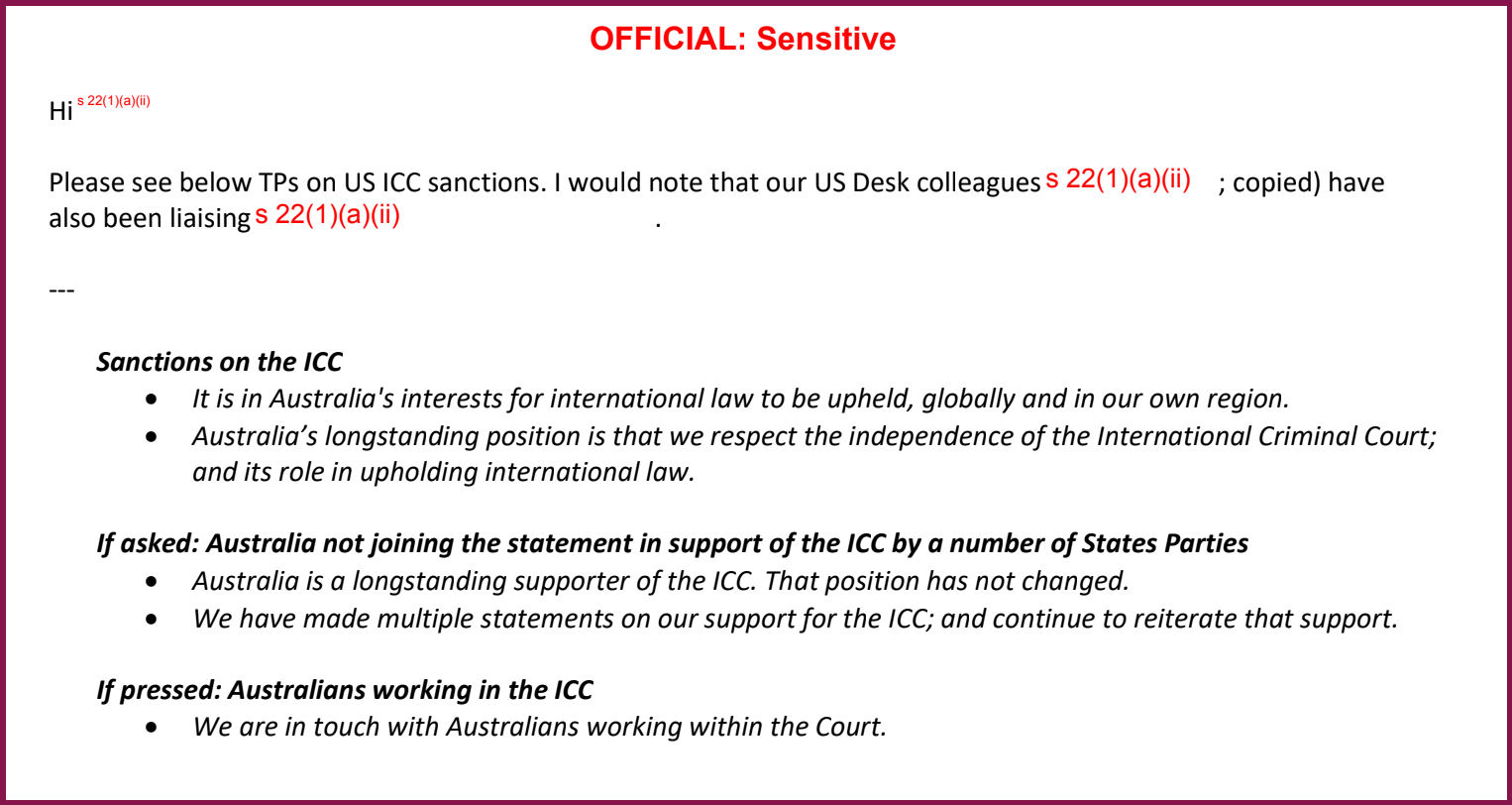
As I reported for Crikey after a Freedom of Information application last year, internal documents showed Australian officials were "closely following" the impact of an earlier round of US sanctions on Australians who worked for the ICC, and were "engaging with the US on this issue".
Elsewhere in Wong's speech on Tuesday, the minister said Australia supported the Geneva Conventions. Awkward, then, that the US's self-styled secretary of war, Pete Hegseth, has vowed "no quarter, no mercy for our enemies" - implying a take-no-prisoners-and-execute-them-instead order that would expressly breach international humanitarian law, including the Geneva Conventions. The US has also faced criticism for carrying out extrajudicial killings of hundreds of people on boats on flimsy justifications, and for the bombing of schoolchildren.
Wong acknowledged that global and regional institutions were not "working as they should" and decision making was "too often paralysed by great power dynamics". She spoke of the need for "amplified middle power diplomacy" and building a wider network of partners to "give Australia more options". The Albanese government, she said, had "never relied on the [US] alliance alone to secure our future". But despite acknowledging the world was changing, Wong did insist Australia needed to hold firm to "our closest ally and principal strategic partner":
"Today, the alliance enhances our security, gives us access to advanced technology and intelligence we could not acquire on our own, and bolsters our capacity to deter aggression.
"Through AUKUS, force posture initiatives, and our wider defence cooperation, our alliance lifts the capability we bring to our own defence and in turn to regional stability."
Those force posture initiatives mean more US troops on Australian soil - and the speech did not directly answer critics who say the increased US presence makes Australia more of a target. “Enhances our security” is taken as a given.
Paul Karp wrote that Wong's speech was "couched in euphemisms", unlike the dramatic speech Canadian prime minister Mark Carney gave at the start of the year about the breakdown of the global rules-based order. Carney diagnosed the world as being "in the midst of a rupture". Wong, by contrast, pointed to the strong results for Democrats at the recent US midterm elections to bolster the unspoken gamble (or hope) that Trumpism was an aberration and that we’ll all return to some version of “normal” soon:
"This change in US strategic posture does not alter the formidable fundamentals of American power: a dynamic economy, unmatched global military power, and an indispensable role in maintaining stability in the Indo-Pacific.
"As we have seen in recent weeks, the US is a vigorous democracy with the ability to remake and reimagine itself."
Wong went on to hit back at unnamed people who, in her telling, "say uncertainty about American policy means Australia should abandon America". Notice how Wong set up this caricature of Australia making some dramatic gesture to "abandon America" and that “uncertainty” is the problem. In this framing, the US is not held as being the one that has stepped back from its traditional relationships by imposing tariffs on Australia and other allies and trashing international law and institutions.
In any case, Wong said said such critics wrongly "present a retreat from the alliance as a road to autonomy". The speech didn't explicitly wrestle with how the AUKUS pact further deepens Australia's dependence on US military equipment and integration with its war planning and was described by its architects as “binding” Australia for decades to come. The option of playing nice with the US but simply avoiding further deepening the risky dependence wasn’t contemplated.
Never mind that in the US, the non-partisan Congressional Budget Office has just published a report warning the AUKUS plan to sell at least three nuclear-powered submarines to Australia in the 2030s would diminish the US navy’s own fleet for “many years”. That matters because even though Australia is sending the US billions of dollars right now to try to speed up shipyard production rates, whoever is US president in the 2030s will need to certify that America's own needs won't be degraded before the transfer of the submarines actually happens. There is no evidence there's a clawback mechanism to refund the cash to Australia if the deal falls over or is delayed.
Defence Minister Richard Marles insists the CBO is "wrong". In an interview with the ABC's Insiders program last Sunday, he said production rates were increasing. He said the CBO report didn't really worry him "because AUKUS is very much happening". Calm down everyone - it's happening because it's happening!
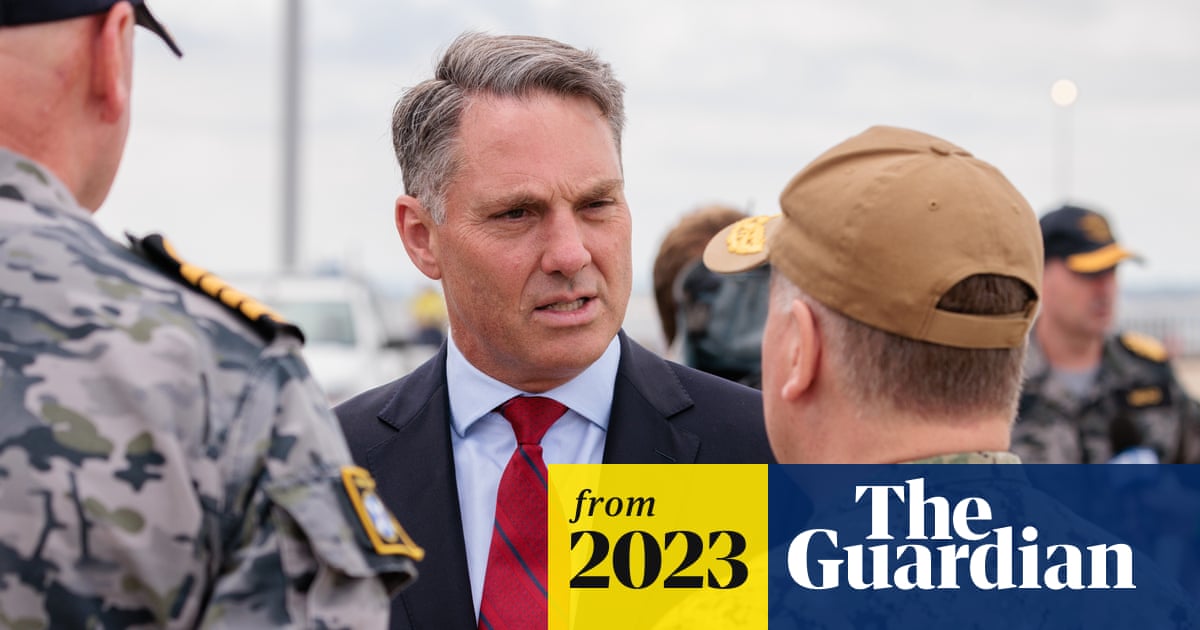
It's at moments like these that I think about what Marles said back in 2023, when he told me in an interview the US, the UK and Australia were “deeply committed to each other’s success in this project” and that was what gave him “a sense of assurance that this is going to play out in the way that we want it to play out”. He said the AUKUS plan "puts all three countries in a position where it’s too big for it to fail on the part of any of those countries".
 Daniel Hurst and Allison Chan and Miles Martignoni and Mell Chun
The phrase "too big to fail" isn't something that normally inspires confidence. It is heavily associated with the banking collapses and bailouts tied to the 2008 global financial crisis. The risk is that so much (political and other) capital has been invested into something that it seems easier to keep going full steam ahead and overlook problems rather than cutting your losses.
**
We also keep learning about other ways in which AUKUS is reshaping things here in Australia. Sweeping new defence powers were rushed through parliament in the past fortnight with very little scrutiny.
The government argues the bill is needed to better protect defence sites from drones, but it goes well beyond that. In the fine print - the explanatory memorandum - the government says the changes are “a key enabler” to “delivering Pillars One and Two of the AUKUS trilateral security agreement and partnership with the United States and United Kingdom”.
Under the new laws, the defence minister has the power to allow a widely defined range of "defence capability" activities such as weapons testing to proceed on Australian soil, overriding state, territory and some federal laws. In some cases, the minister could even choose to keep these decisions secret from the public.
The laws also set up a system of defence security zones, which can include permanent, temporary, mobile and emergency declarations. Protests can be moved on if they could "risk" or obstruct defence purposes.
As Amy Remeikis, who has led on coverage of these laws, has reported, the Department of Defence has told private contractors the legislation may be used, where necessary, to protect defence activities at privately owned industry facilities.
Prime Minister Anthony Albanese told reporters on Monday not to "jump at shadows". When asked again in parliamentary question time on Thursday about concerns about the rushed legislation, Albanese said that "we live in an unsafe world" and he had "seen some nonsense on social media ... that simply feeds conspiracy theories that don't just come from the far right but can come from the far left as well".
In no way can the esteemed legal expert Anne Twomey fit that dismissive description. Twomey, a Professor Emerita at the University of Sydney in the field of Constitutional Law, says the idea of "permitting secret alterations to Commonwealth, state and territory laws is a very serious development" and she finds it "just astonishing that it was not the subject of proper debate or scrutiny before this law was enacted".
In an article in Pearls and Irritations that is well worth your time, Twomey explained that the definitions in the bill were very broad and defence activities could include activities done by the private sector, such as arms manufacturers, and by foreign defence officials. She gave this hypothetical:
"For example, if State planning law prohibited the construction of a datacentre in a residential area, it could go ahead if the Defence Minister exempted it from such a law because the datacentre was reasonably necessary for defence purposes, or connected with Australia’s international defence relationships, such as AUKUS."
Twomey acknowledged defence laws needed to be updated for modern times:
"But instead of working out what laws need to change to accommodate defence needs and balance them against the needs and rights of the community, the Parliament has effectively just given up and instead given the power to the Minister, or senior public servants or defence officers, to make decisions that exclude the application of certain existing laws to defence activities.
"It is a lazy and irresponsible abandonment by Parliament of both its scrutiny and law-making roles, raising the risk that these powers will be misused in the future. ...
"Who knows what will be treated as defence capability in the future, or what laws it will be exempted from? What might seem fine now when exercised by reasonable and cautious people, might be deeply regretted in 20 years’ time, when it is used abusively and oppressively. If that doesn’t happen, it will be due to good luck, rather than wise parliamentary action."
To which we might add: If this power is misused, it will be done by men with swords quoting laws.
If you liked this article, please share it with friends.
Recent posts:
Ethical disclosure: I do not use generative AI for any of my research or writing.